Kilimanjaro Trekking Tours
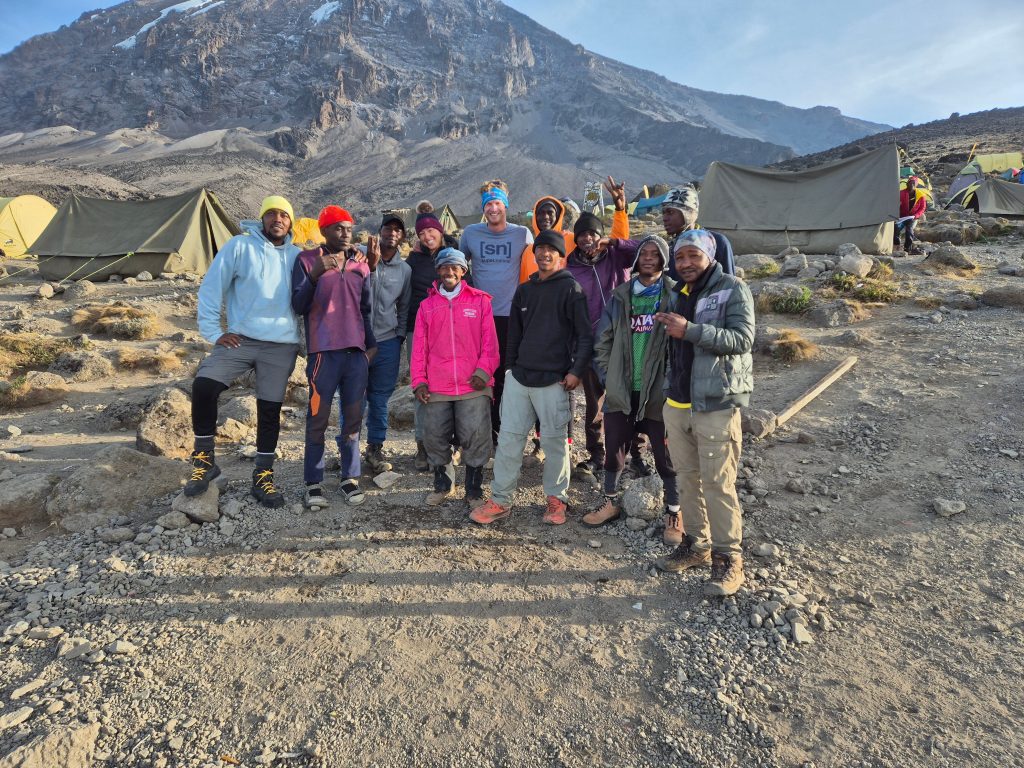
Kilimanjaro trekking tours are guided climbs of five to nine days led by licensed Tanzanian operators, with a crew of guides, porters and a cook carrying camp and food while you walk. Independent trekking is not permitted, so choosing the operator matters as much as choosing the route. Tours run year round on seven trails inside Kilimanjaro National Park in northern Tanzania, finishing at Uhuru Peak, 5,895 metres.
How a Guided Kilimanjaro Trekking Tour Works
A Kilimanjaro trekking tour is not a walk you could do alone with a permit. Park regulations require every climber to travel with a registered operator and a licensed guide, and the practical reality behind that rule is that the mountain needs a team.
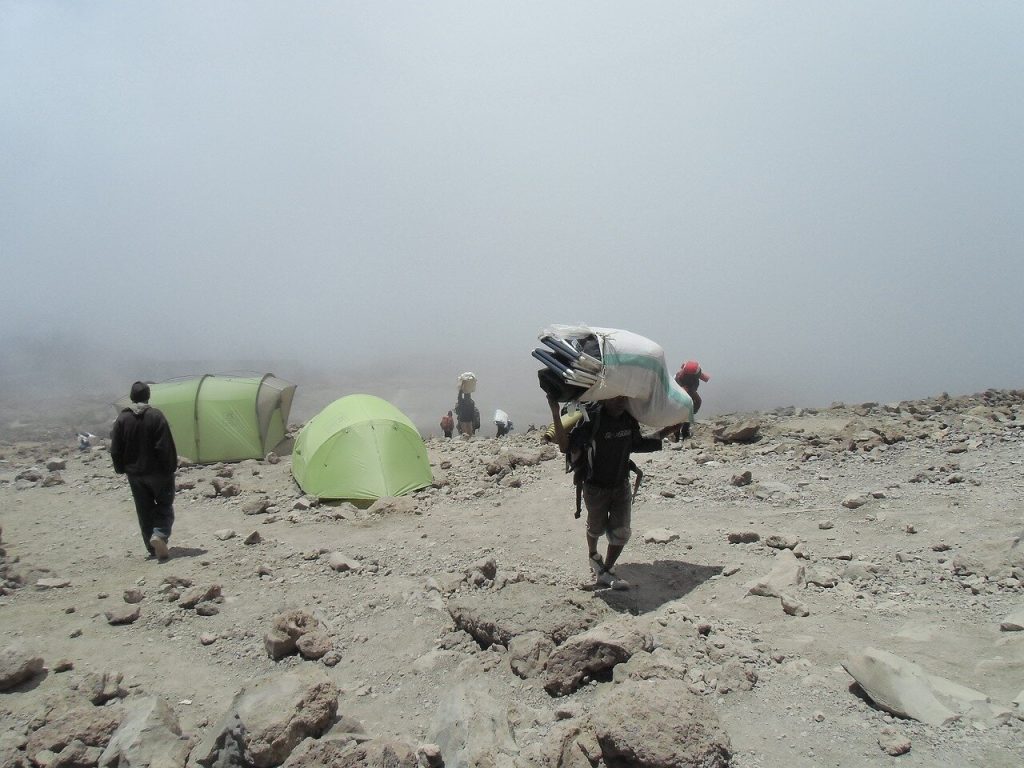
Your crew moves the camp. Porters leave after you in the morning, overtake you on the trail carrying tents, food, water and your duffel, and have camp standing when you arrive. The cook has hot drinks and a meal ready. Guides walk with you, set the pace deliberately slower than you would choose, and run health checks twice a day.
For two climbers on a seven day tour that usually means around ten people: a lead guide, an assistant guide, a cook and six or seven porters. It sounds like a lot until you see the loads.
Your own job is to walk, eat, drink and sleep. You carry a daypack with water, snacks, rain gear and a warm layer, because your duffel goes ahead and you will not see it until camp.
The most repeated instruction on any Kilimanjaro tour is pole pole, Swahili for slowly, slowly. Guides are not commenting on your fitness. Walking slower than feels natural is the single most useful thing you can do, and the trekkers who finish last into camp are frequently the ones who reach the summit.
Choosing a Kilimanjaro Trekking Tour Operator
Route choice gets all the attention and operator choice matters at least as much. Six questions separate the serious companies from the rest, and any decent operator will answer them without hedging. Compare what each quote covers as well, since a standard climb package should carry park fees, crew, all meals and camp equipment as a matter of course.
Are you a partner of the Kilimanjaro Porters Assistance Project? That partnership means wages, load limits of 20 kilograms per porter, meals and shelter are independently monitored against a published scorecard each season. A large share of expeditions on the mountain do not meet those standards.
What training do your guides have, and is it current wilderness first aid? Do you carry bottled oxygen and a pulse oximeter on every climb? How often are health checks run, and are they recorded? What is your turnaround policy, and who decides? And critically, how many assistant guides travel with a group, because if one climber needs to descend on day five, somebody has to take them down without ending everyone else’s tour.
An operator who talks openly about sending a sick client down at their own commercial cost is telling you something a summit percentage on a homepage cannot.
Your Guides, Porters and Cook on a Kilimanjaro Trek
The lead guide runs the tour and makes the decisions that matter. Good ones are watching you constantly without making it obvious: your pace, your appetite, how you sleep, whether you are talking less than yesterday. Most have summited dozens or hundreds of times and grew up on these slopes.
Assistant guides matter more than their title suggests. They allow the group to split when it needs to, whether that is a slower walker on the trail or someone descending mid trek. Ratios of roughly one assistant per four climbers are the standard worth expecting.
Porters are the backbone and the part of the industry most exposed to price cutting. Loads are capped at 20 kilograms and your duffel is limited to 15 kilograms including your sleeping bag, weighed at the gate. Speciality roles carry extra responsibility: a waiter who serves meals, a toilet porter on tours with a private toilet tent, and summit porters who walk with the group on the final night.
The cook works out of a tent in wind and cold at 4,000 metres and produces three meals a day. It is a harder job than it sounds and it directly affects whether you eat enough to keep climbing.
Daily Life on a Kilimanjaro Trekking Tour
The rhythm is the same on every route and it becomes oddly comfortable within two days.
Woken with tea or coffee at the tent around six or seven, warm water in a bowl to wash. Breakfast in the mess tent. Pack your duffel and leave it for the porters. Walk four to seven hours with a stop for lunch, either a packed lunch on the trail or a hot one at a midway point.
Arrive at camp in the afternoon, usually to find tents pitched and a bowl of popcorn and hot drinks waiting. Your guide runs a health check with the pulse oximeter and asks how you slept and whether you have a headache. Some days there is an optional acclimatisation walk in the late afternoon, and taking it is almost always the right call.
Dinner around six or seven, then bed early because there is nothing else to do and you are tired. Nights are cold and get colder as you climb. Sleep is patchy for most people above 4,000 metres, and lying still in a warm bag counts for more than nothing.
Food and Water on a Kilimanjaro Trekking Tour
Better than most people expect, and eating it is part of the work. Porridge, eggs, toast and fruit for breakfast. Soup with most meals, which is easier to get down than solid food at altitude. Rice, pasta, stews, vegetables and plenty of carbohydrates for dinner, with fresh fruit and snacks along the way.
Appetite disappears above about 4,000 metres for almost everyone. Eat anyway. Carbohydrates increase your ventilation rate and are the most useful fuel in thin air, which is why your cook will keep putting starch in front of you and your guide will keep noticing whether you finished it.
Water is collected from streams and springs on the mountain, then boiled or filtered by the crew. Aim for three to four litres a day, more than most people manage without deliberate effort. Wide mouth bottles beat a hydration bladder, because hose tubes freeze solid on summit night. Operators can usually accommodate vegetarian, vegan, halal and gluten free diets with notice.

Nobody fails on Kilimanjaro because the food was disappointing. Plenty of people struggle because they stopped eating it around 4,300 metres and had nothing left for summit night.
Safety Protocols on a Kilimanjaro Trekking Tour
Altitude sickness is the leading reason climbers turn back and, in rare cases, the reason people die on this mountain. It does not track fitness, age or sex.
Good tours run twice daily checks combining a pulse oximeter reading with symptom scoring against the Lake Louise system, which gives guides an objective picture rather than a guess. Mild symptoms feel like a hangover: headache, nausea, no appetite, broken sleep. The severe forms, fluid on the lungs or swelling of the brain, can develop fast and are treated by descending immediately, since dropping 500 to 1,000 metres usually resolves symptoms quickly.
Bottled oxygen is carried for emergencies, not as a way to push a struggling climber higher. Helicopter evacuation is available from designated points on the mountain, which is why travel insurance covering trekking above 5,000 metres and evacuation is not optional.
Tell your guide about a headache the first time you feel it rather than the third day. Concealing symptoms to protect your summit chances is the most common mistake on the mountain and it usually costs the summit anyway.
Kilimanjaro Trekking Tours by Route
Lemosho tours. Seven or eight days from the west, crossing the Shira Plateau. The most recommended tour for first timers, with around 90 percent reaching the summit on eight days.
Machame tours. Six or seven days from the south, the most widely sold and easiest to join at short notice. Roughly 85 percent on seven days.
Marangu tours. Five or six days from the east, the only tour with hut accommodation. The weakest record on the mountain at 27 to 65 percent.
Rongai tours. Six or seven days on the dry northern flank, quiet and gentle underfoot, and the sensible pick in wet months.
Northern Circuit tours. Nine days looping the mountain, the quietest tour available and the strongest record at 90 to 95 percent.
Umbwe and Shira tours. Specialist. Umbwe is the steepest trail and suits experienced high altitude trekkers; Shira starts high by vehicle and skips the forest.
Private, Group and Specialist Kilimanjaro Trekking Tours
Group joining tours put you on a scheduled departure with other climbers and share the crew cost, which makes them substantially cheaper. Groups typically run four to twelve people and guide ratios stay the same as the group grows.
Private tours give you your own crew and date, suiting families, couples, and charity or corporate groups. Costs per person climb as the party shrinks, and solo trekkers pay most because one climber still needs a lead guide, a cook and several porters. How those figures are built up, from park charges through to crew wages, is set out in what a Kilimanjaro climb actually costs.
Specialist tours exist for particular needs. Women only departures, tours run at a deliberately slow pace for older climbers, charity challenge groups, and combined itineraries that spend three or four days on nearby Mount Meru at 4,562 metres first as pre acclimatisation, which is the most useful preparation available in the region. A handful of operators run daytime summit variants, reaching the crater rim in daylight rather than before dawn, which some climbers find considerably easier mentally.
Adding a Safari or Beach Extension to Your Kilimanjaro Tour
Wildlife on the mountain itself is limited. Colobus and blue monkeys are commonly seen in the forest zone and there are over 180 bird species, but nobody climbs Kilimanjaro for game viewing and elephant sightings on the lower western and northern slopes are uncommon.
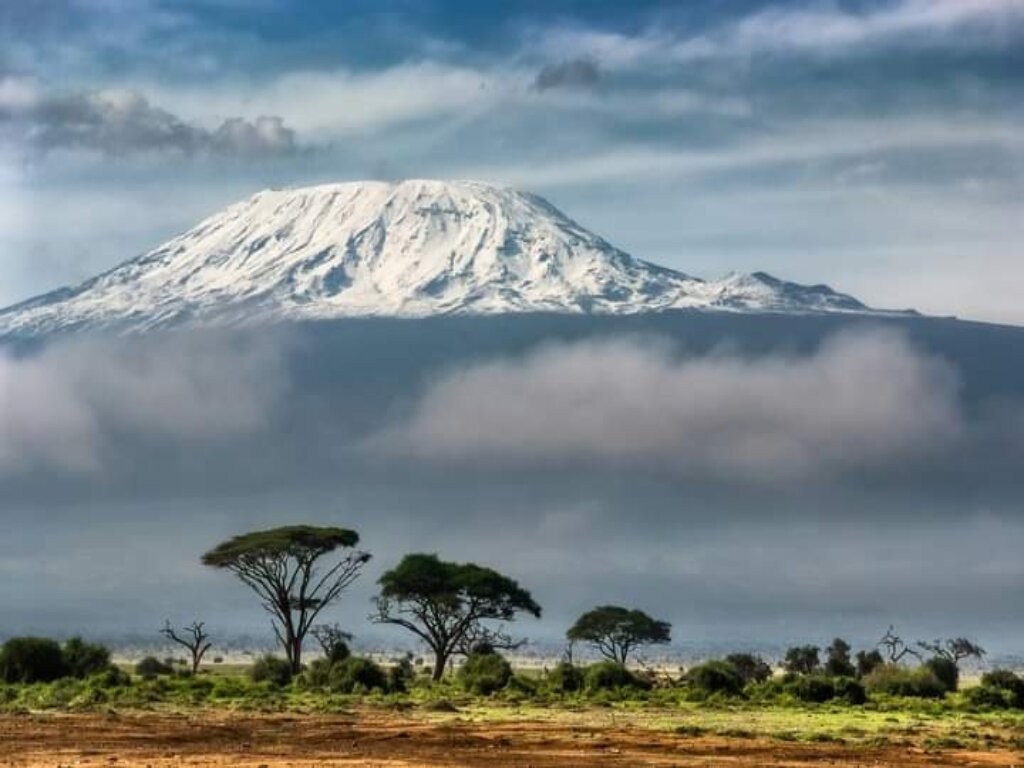
Arusha sits at the gateway to Tanzania’s northern safari circuit, so a two to four day extension covering Tarangire, Lake Manyara, the Ngorongoro Crater and the Serengeti is a natural addition and usually cheaper booked together than separately. Nine day climb and game drive itineraries are the shortest way to fit both into one trip. Zanzibar is the other common pairing, a short flight to the coast for several days at sea level after a week in the cold, usually as a twelve day trip with a few nights on the beach.
Schedule extensions after the trek rather than before, and build in a rest day. Starting a climb straight off a safari leaves you slightly worn down at exactly the wrong moment. Longer combinations absorb that rest day without effort, which is the argument for a full fortnight covering climb, safari and coast.
Getting to Kilimanjaro for Your Trekking Tour
Fly into Kilimanjaro International Airport, which sits between Moshi and Arusha and is roughly an hour from Moshi by road. Almost every tour includes the transfer. Nairobi is the alternative, followed by a road crossing at Namanga, which sometimes saves on airfare and costs a day each way.
Moshi is the standard base and where gear rental shops and most briefings are. Trailhead transfers vary considerably: under an hour for Machame and Marangu, two to four hours plus a forest track for Londorossi in the west, and around three and a half hours of rough road for Rongai in the north.
Arrive at least a day before your briefing. A delayed bag becomes an inconvenience rather than a crisis, and you have time to rent whatever did not turn up.
Frequently Asked Questions About Kilimanjaro Trekking Tours
The questions below come up on almost every enquiry. Broader ground, from visas and fitness to what actually happens on the mountain, is covered in the site-wide answers for first time Kilimanjaro climbers.
How much do Kilimanjaro trekking tours cost?
Budget tours run about $1,500 to $1,900 per person, mid range $2,200 to $3,500, and luxury or private tours $4,500 and above. By route, five and six day Marangu is $1,200 to $2,200, seven day Machame $2,000 to $3,000, eight day Lemosho $2,400 to $3,500 and nine day Northern Circuit $2,800 to $3,800. With flights, tips, insurance and gear, a realistic all in figure is $4,000 to $6,500.
What is included in a trekking tour price?
All park charges, which come to roughly $800 to $1,000 on a seven day tour, comprising conservation fees near $70 per person per day, camping fees around $50 per night and a one off rescue fee of about $20. Also guides, porters and cook with their wages, all meals and filtered water, tents and camp equipment, transfers, a briefing and usually one or two hotel nights in Moshi. Flights, visa, insurance, tips and personal gear are excluded.
How much should I tip the crew?
Roughly $250 to $350 per climber on a six or seven day tour and $350 to $450 on an eight or nine day one, with solo trekkers paying more. Pooled across the group rather than per climber, the guidance is $20 to $25 a day for the lead guide, $10 to $15 for assistant guides and the cook, and $5 to $10 for each porter. Crew wages are a base amount that tips top up, so this is expected rather than optional. Bring clean US dollar notes.
Can I climb Kilimanjaro without a tour operator?
No. Park regulations require every climber to travel with a registered operator and licensed guide, and permits are issued through operators rather than to individuals. Beyond the rule, the practical case is strong: the crew carries camp, food and water, and the guides carry the oxygen and make the health decisions that keep people safe at altitude.
What happens if I cannot continue partway through the tour?
An assistant guide takes you down while the rest of the group carries on, which is exactly why guide ratios matter when you compare operators. Descent is usually on foot to a lower camp or gate, with helicopter evacuation available from designated points for serious cases. Your travel insurance needs to cover trekking above 5,000 metres and evacuation, since many standard policies exclude both.
Do tours cater for special diets?
Yes, with notice. Vegetarian, vegan, halal and gluten free diets are routinely handled, and cooks are used to working around them. Tell your operator at booking rather than at the briefing, since food is bought and portioned before the tour starts. Eating enough at altitude matters more than eating exactly what you would at home.
Which tour is best for a first time trekker?
An eight day Lemosho tour for most people, or seven day Machame if budget is tighter. What matters more than the route is the number of nights and the operator’s safety practices. Avoid five day itineraries, ask about KPAP partnership and oxygen, and check how many assistant guides travel with the group.
Booking Your Kilimanjaro Trip
The safari companies and tour operators listed on this website put trips like this together for a living and know which camps, guides and routes actually deliver. We are an independent guide to Kilimanjaro; we do not book or sell tours ourselves. If you are weighing two quotes and cannot tell them apart, send us the details and we will tell you what to ask.
When you are ready, arrange your safari, tour or holiday with one of the recognised operators listed here. Tell them your dates and what matters most, and a real person, not a form, will handle the itinerary, park bookings and logistics for you.