Machame Route

The Machame Route is a six or seven day camping trek up Mount Kilimanjaro, covering roughly 62 kilometres from Machame Gate on the south western side to Uhuru Peak and out via Mweka. It is the most booked route on the mountain, with around 85 percent of seven day climbers reaching the top. Machame sits inside Kilimanjaro National Park in northern Tanzania and is nicknamed the Whiskey route.
Machame Route Trekking at a Glance
Machame route trekking earned its popularity honestly. The trail climbs the southern slope, crosses to the Shira Plateau, swings east beneath Lava Tower, drops into the Barranco Valley, then works along the base of the southern ice fields to Barafu for the summit push. In one week you walk through rainforest, moorland, alpine desert and arctic ground.
The name is a joke at Marangu’s expense. If the old hut trail on the eastern side is the Coca Cola route, Machame is the harder drink: steeper in places, tents rather than bunks, and a good deal more up and down. That up and down is the point. The profile takes you high during the day and brings you back down to sleep, and that pattern is what makes this trek work at altitude.
Height gain from the gate to the summit is about 4,157 metres. Barafu, the high camp, sits roughly 1,550 metres above the trailhead, which is a bigger spread than Marangu offers and one reason the trek has a better record.
Machame is busy. In July and August you will share campsites with several hundred other trekkers and the Barranco Wall can back up in the morning. If crowds bother you more than budget does, Lemosho joins this same trail after two quieter days and gets you the same scenery.
Day One of the Machame Trek Through the Rainforest
You drive from Moshi to Machame Gate at about 1,800 metres, sign the park register, and start walking after lunch. The first day is five to seven hours through dense montane forest on a trail that is often wet underfoot even in dry months, since this side of the mountain catches a lot of cloud.
Colobus and blue monkeys are commonly seen here and the birdlife is loud, though the canopy hides most of it. There is no view to speak of, which surprises people. What you get instead is warmth, moss, mud and the useful business of your legs finding a rhythm before altitude becomes the issue.
Machame Camp sits at around 3,000 metres at the top edge of the forest. This is where you meet camp life properly: your tent already pitched, hot water in a bowl, dinner in the mess tent, and the first of many pulse oximeter readings.
Machame Trekking Day Two Across the Moorland to Shira
Morning two leaves the trees behind within an hour. The trail steepens onto open moorland covered in heather and giant groundsel, with volcanic rock draped in lichen, and for the first time Kibo is visible ahead of you.
It is a shorter day than the first, five or six kilometres over four to six hours, gaining around 800 metres to New Shira Camp at roughly 3,850 metres. Short does not mean easy. This is where most people first notice the altitude, usually as a headache in the afternoon or an appetite that has quietly disappeared.
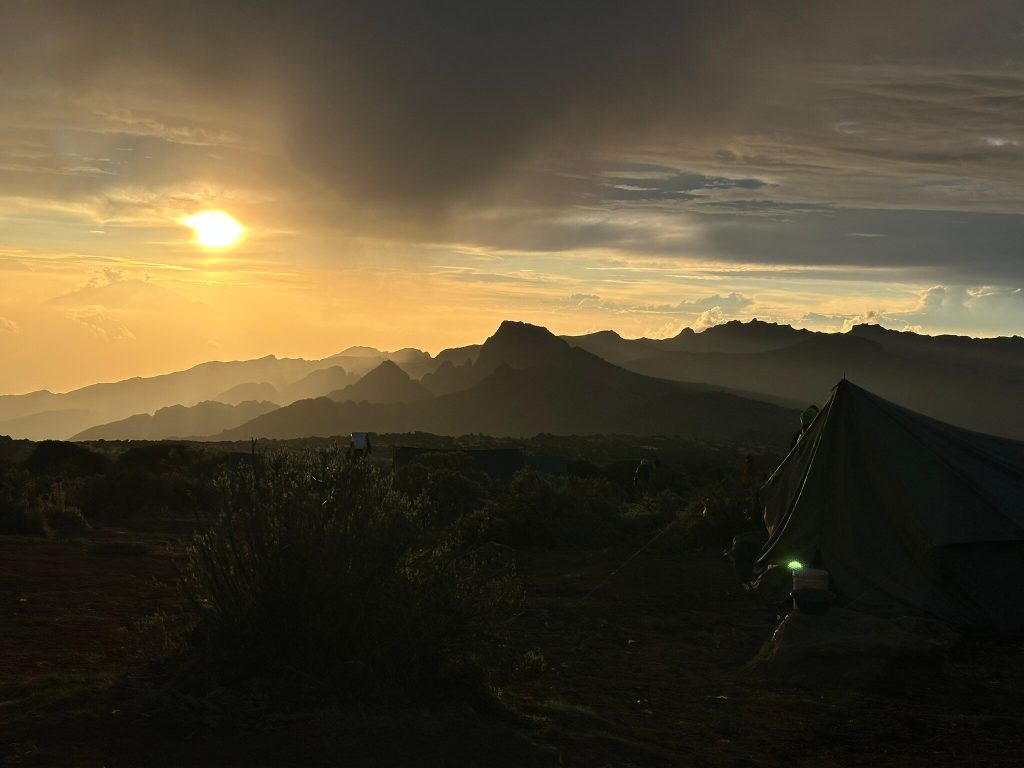
Eat anyway. Drink more than you want to. The evening at Shira, with the plateau opening westwards and sunset light on the massif, is one of the better campsites on the mountain. Out across that plateau runs the older Shira trail, which reaches this height by vehicle rather than on foot.
Machame Route Trekking via Lava Tower to Barranco Camp
Day three is the acclimatisation day even though nobody calls it that. You walk east and up towards Lava Tower, a volcanic plug at about 4,640 metres that guides nickname the Shark’s Tooth, then descend into the Barranco Valley to camp at around 3,985 metres. Lava Tower is also where the Lemosho trail merges with this one, and everything beyond it is shared.
Ten kilometres, five to seven hours, and a net height gain of barely 100 metres. Your body spends several hours at over 4,600 metres and then sleeps 700 metres lower, which is exactly the stimulus you want. Climbers who feel rough at Lava Tower and much better at camp are experiencing the system working as intended.
Barranco Camp sits in a bowl beneath the Breach Wall with the southern ice fields hanging above it and giant senecio trees scattered across the slope. It is the most photographed campsite on Kilimanjaro, and in the morning you get to look straight up at the wall you are about to climb.
Barranco Wall Climbing and the Karanga Valley
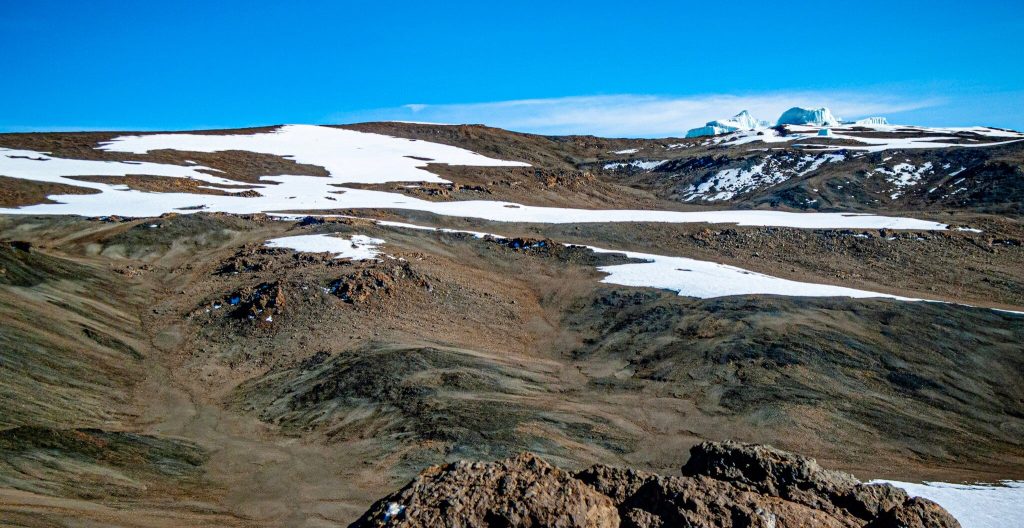
The Barranco Wall is a 257 metre rock face and it is the part of the trek people worry about in advance and enjoy most in hindsight. It is a scramble, not a climb. There are no ropes and no exposure that a steady walker cannot handle, but you will use your hands, so stow the poles before you start.
An hour or so of switchbacks brings you out on top, above the cloud, with the summit standing clear ahead. There is a spot near the top where every group stops for photographs and nobody minds. From there the trail runs along ridges and down into the Karanga Valley, a steep drop of about 140 metres followed by a climb back up to Karanga Camp at roughly 4,000 metres.
Total distance is around five kilometres in four hours. On the seven day itinerary you sleep here. On the six day version you stop for lunch and keep walking to Barafu, which is the single decision that most affects your odds on this route.
Machame Route Trekking to Barafu Camp
A short day and a serious one. Three to four kilometres, four to five hours, climbing about 640 metres through alpine desert to Barafu Camp at roughly 4,670 metres. Barafu means ice in Swahili and the camp lives up to it: a rocky exposed ridge, wind most afternoons, nothing growing.
You arrive around midday deliberately. The afternoon is for eating, drinking, a gear check with your guide, and trying to sleep from early evening. Very few people sleep well. Thin air, cold, and the knowledge of what happens at midnight all conspire against it, and guides will tell you that lying still with your eyes shut counts for something.
From Barafu you can see Mawenzi’s spires across the saddle and the bulk of Kibo above. Water freezes overnight here, so bottles go inside the sleeping bag and hose systems get left behind.
Machame Route Summit Night Climb to Uhuru Peak
Wake up is around 11pm for a midnight departure. Hot tea, a biscuit, headlamps on, and then five or six hours of switchbacks up loose scree in the dark at a pace that feels absurdly slow and still leaves you breathing hard.
The distance from Barafu to the crater rim is only about five kilometres. It takes five to seven hours. Temperatures sit between roughly minus seven and minus twenty degrees Celsius before dawn and the wind chill takes it lower, which is why the down jacket, the balaclava and the second pair of gloves all come out of the daypack.
Machame trekkers reach the rim at Stella Point, around 5,750 metres, usually as the sky starts to colour. From there it is about an hour of gentler walking along the crater edge past the glaciers to the wooden sign at Uhuru Peak at 5,895 metres. You get a few minutes, some photographs and a look down at the Rebmann and Furtwängler ice, then you turn around, because standing still at that altitude in that cold helps nobody.
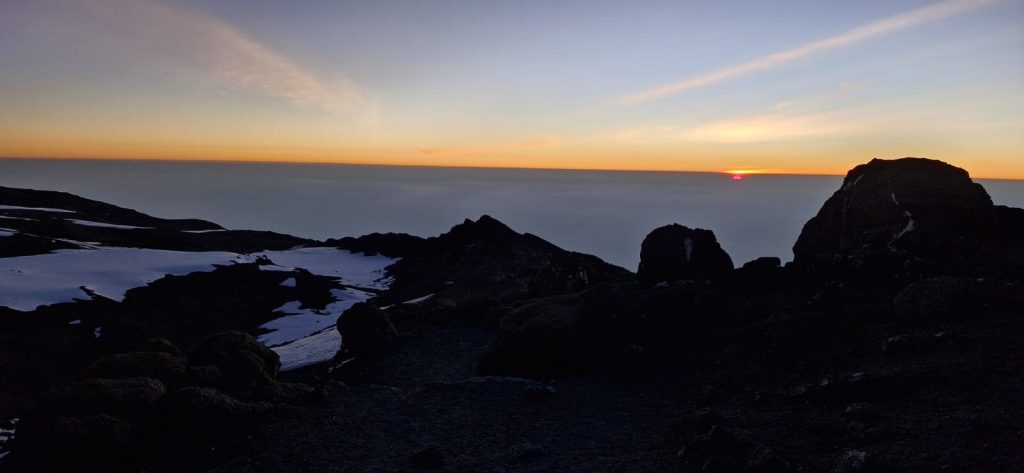
Reaching Stella Point in the dark and knowing the hard part is behind you is the moment most Machame trekkers describe afterwards, more than the sign at the top.
Machame Trek Descent via Mweka Gate
You drop back to Barafu on scree, which is quick and hard on the knees, rest and eat, then keep going down to Mweka Camp at around 3,100 metres. Total time on the move from midnight is often twelve to fourteen hours. It is the longest day of the trek by a wide margin.
The last morning is a short three to four hour walk down through the forest to Mweka Gate, where you sign out and collect your certificate. Green paper for Stella Point, gold for Uhuru. Then a transfer to Moshi, a shower that ranks among the best of your life, and dinner with your crew.
Six Day or Seven Day Machame Trekking
Six days. Skips the night at Karanga, walking Barranco to Barafu in one push. Reported summit rates around 50 to 73 percent depending on operator. Suits walkers with prior high altitude days behind them.
Seven days. Adds the Karanga night, an easy walking day at 4,000 metres. Summit rates commonly quoted at 85 percent and above. This is the version experienced operators recommend for almost everyone.
What the extra day costs. One more day of park charges, crew wages and food, which is a few hundred dollars. Set against a wasted trip, the arithmetic is not close.
Statistically, seven day Machame trekkers are 10 to 15 percent more likely to reach the summit than six day ones. If your leave allows only six days on the mountain, a six day Machame is a reasonable trek. If it allows seven, there is no argument.
Best Time for a Machame Route Trek
Two windows suit this trail. January to early March brings warmer days, clear mornings and often snow on the crater rim, with fewer people than midsummer. Late June to October is the long dry season: colder at height, the most settled weather of the year, and the busiest weeks on the trail during July and August. September and early October stay dry and thin out noticeably.
April and May are the long rains and Machame’s forest section, already the wettest part of the route, becomes properly muddy. November into early December brings shorter rains. Trekking is still possible in both, and prices drop, though the southern side of the mountain takes the worst of it and the dry northern flank holds up better.
Getting to Machame Gate for Your Trek
Fly into Kilimanjaro International Airport, between Moshi and Arusha. Moshi is the natural base for this route, about an hour from the airport and around 45 minutes to an hour from Machame Gate itself, which makes for one of the easier trailhead transfers on the mountain.
Plan a night in Moshi before your briefing, so a delayed bag does not derail the climb, and a night afterwards. Sleeping bags, down jackets, poles and gaiters can all be rented in town if you would rather not buy kit for a single week.
Frequently Asked Questions About the Machame Route
How much does a Machame route trek cost?
A well supported seven day Machame climb usually runs between $2,000 and $3,000 per person with a mid range operator, and around $2,600 is a common figure. Budget group departures start nearer $1,700 to $2,000, while premium private climbs go past $4,000. Anything advertised much under $1,500 is being funded somewhere, usually from porter wages. Flights, visa, insurance, tips and personal gear sit outside almost every package.
What park fees are included in a Machame climb?
Conservation fees of roughly $70 per person per day, camping fees of about $50 per person per night, a one off rescue fee near $20, and small per head park charges for every guide, porter and cook. Most published tariffs exclude the 18 percent VAT, which is why the same seven day trek can look different on two websites. On a seven day Machame the fixed park bill alone runs to several hundred dollars before anything else, and reputable operators pay it directly and include it in your quote.
How difficult is the Barranco Wall?
Easier than it looks from Barranco Camp. It is a non technical scramble of about 257 metres taking roughly an hour, with one or two places where you put a hand on the rock for balance. Trekkers in their sixties and seventies do it every week. Pack your poles away first and let the porters, who move faster and carry more, go past.
How much should I tip on a Machame trek?
Budget around $250 to $350 per climber for a seven day trek. The commonly used daily figures, pooled across the group rather than paid per person, are roughly $20 to $25 for the lead guide, $10 to $15 for assistant guides and the cook, and $5 to $10 for each porter. A pair of climbers on seven days typically has a crew of about ten. Bring clean US dollar notes from home.
Do I sleep in tents on the Machame route?
Yes, every night. Marangu is the only Kilimanjaro route with huts. Your operator carries tents, sleeping mats, a mess tent, tables and chairs, and porters pitch camp before you arrive. You bring or rent a four season sleeping bag rated well below freezing.
How fit do I need to be for Machame?
Fit enough to walk five to seven hours on rough uneven ground on consecutive days. Eight to twelve weeks of hill walking in the boots and daypack you plan to use is the most useful preparation. No technical skills are needed. Being very fit is not protective against altitude sickness, and fast walkers often fare worse than slow ones.
Booking Your Kilimanjaro Trip
The safari companies and tour operators listed on this website put trips like this together for a living and know which camps, guides and routes actually deliver. We are an independent guide to Kilimanjaro; we do not book or sell tours ourselves.
When you are ready, arrange your safari, tour or holiday with one of the recognised operators listed here. Tell them your dates and what matters most, and a real person, not a form, will handle the itinerary, park bookings and logistics for you.