Mount Kilimanjaro Climbing Guide

A Mount Kilimanjaro climbing trek takes five to nine days on foot, requires no ropes or technical mountaineering skill, and must be done with a licensed guide inside Kilimanjaro National Park. Most people book an all inclusive trekking package covering permits, crew, meals and camping. Kilimanjaro is a dormant volcano in northern Tanzania near Moshi, topping out at 5,895 metres at Uhuru Peak, the highest point in Africa.
What a Mount Kilimanjaro Climbing Trek Actually Involves
Climbing Kilimanjaro is a long uphill walk at thinning altitude, not a climb in the rope and harness sense. You walk between four and seven hours on most days, sleep in a tent (or a hut on one route), and eat food cooked for you at camp. The physical skill required is the ability to keep putting one boot in front of the other while breathing hard.
What makes it serious is the air. The summit sits at roughly half the oxygen you are used to at sea level. That single fact drives almost every decision on the mountain: how many days you book, how slowly you walk, how much water you drink, and whether your guide lets you go up on summit night.
The park requires that every trekker climbs with a registered operator and a licensed guide. Solo trekking is not allowed. Your crew usually includes a lead guide, one assistant guide per few climbers, a cook, and a team of porters who move the camp ahead of you each morning. For two climbers on a seven day trek, a normal crew runs to around ten people.
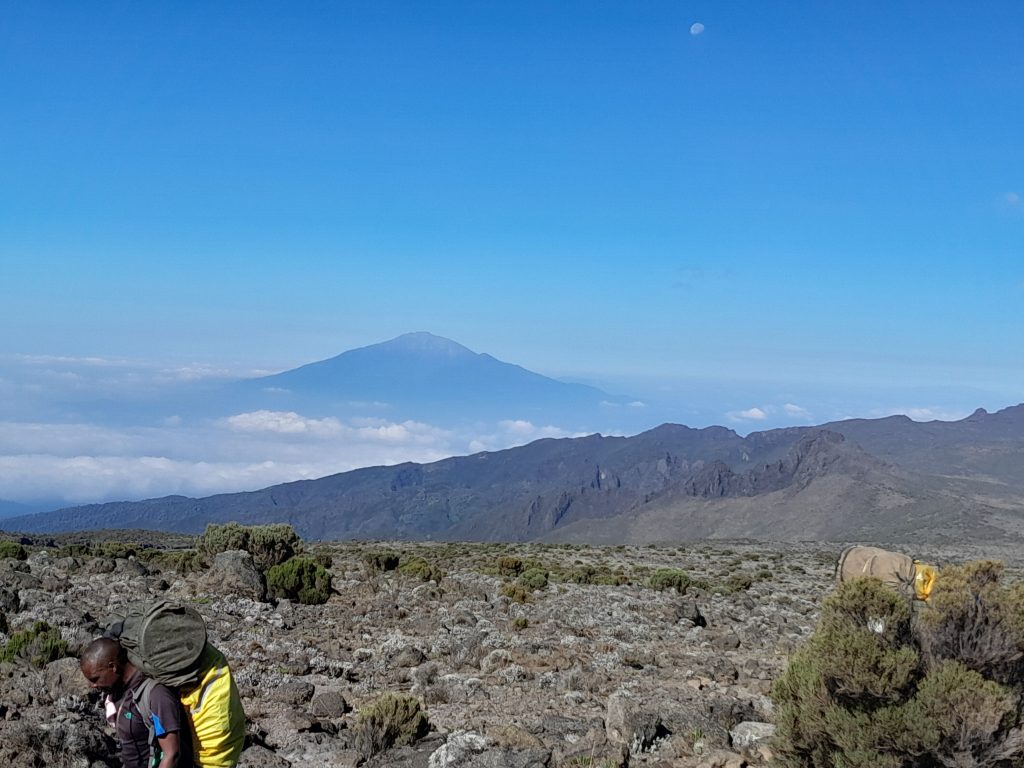
You will hear the phrase pole pole from your guide within the first hour. It means slowly, slowly. Guides are not being polite about your fitness. Walking slower than feels natural is the single most useful thing you can do on the mountain, and the climbers who ignore it are usually the ones who turn back.
Choosing Your Kilimanjaro Climbing Route
Seven trekking routes lead to the summit, and picking one is the biggest planning decision you will make. Each starts on a different flank, has its own scenery and, more to the point, its own altitude profile.
Machame. Comes at the mountain from the south, six or seven days, camping. The busiest trail, with good climb high and sleep low sections and the scramble up the Barranco Wall.
Lemosho. Starts west at Londorossi Gate, seven or eight days, camping. Quiet forest opening, crosses the Shira Plateau, then joins the southern trail. Widely rated the best all round trek.
Marangu. Eastern side, five or six days, sleeping in huts at Mandara, Horombo and Kibo. The only route that goes up and down the same path, and the one with the weakest record for reaching the top.
Rongai. The only northern trek, six or seven days. Drier than the southern trails and quiet, but with fewer chances to gain height and then drop back down to sleep.
Northern Circuit. Eight or nine days, looping the northern slopes. The longest trek on the mountain and the one where most climbers reach Uhuru Peak.
Shira and Umbwe. Shira starts high on the western plateau by vehicle. Umbwe climbs a steep southern ridge fast and is the hardest trek up Kilimanjaro. Both are lightly used.
If you want one sentence of guidance: book the longest itinerary your holiday and budget will carry, on whichever of Lemosho, Machame or the Northern Circuit suits you. Route scenery matters and people do fall in love with a particular flank of the mountain, yet nothing on your booking form affects your odds more than the number of nights you spend above 3,000 metres.
How Many Days a Kilimanjaro Trek Takes
Five days is the legal minimum on Marangu. It is also close to the worst plan available. Park figures put five day treks at roughly a quarter to a third of climbers reaching the summit, while eight and nine day itineraries run somewhere around ninety percent with a competent operator. Same mountain, same fitness, four extra nights. Short itineraries are also the cheapest way up the mountain, which is exactly why they keep selling.
Six days is tight but workable on Machame or Rongai if you have hill walking behind you. Seven is the sensible middle. Eight gives your body a genuine chance to catch up, and it is what most experienced operators quietly steer first timers towards.
Add two nights in Moshi or Arusha either side of the trek, plus travel days, and a Kilimanjaro trekking tour realistically eats ten to twelve days of leave.
Altitude and Acclimatisation on a Kilimanjaro Climb
Acute mountain sickness is the reason most people fail on Kilimanjaro, and it does not care how fit you are. Marathon runners get it. Sedentary office workers sometimes sail through. The pattern that does hold is that fast climbers, who tend to be the fit ones, get hit harder because they outrun their own physiology.
Mild symptoms feel like a bad hangover: headache, no appetite, broken sleep, mild nausea. Guides on good teams run twice daily health checks with a pulse oximeter and score symptoms against the Lake Louise system, then act on what they find. Severe forms, fluid on the lungs or swelling of the brain, are rare but move fast and are treated by going down, immediately and with company.
Drink three to four litres a day. Eat the carbohydrates put in front of you even when you do not want them. Skip alcohol and sleeping pills. Tell your guide about a headache the first time you feel it rather than the third day. Acetazolamide, sold as Diamox, speeds up the body’s own adjustment and is worth a conversation with your doctor before you fly, along with a warning about tingling fingers and extra trips out of the tent at night.
Altitude is the leading cause of trouble on this mountain, and the three things that reduce it are all decided before you arrive: a longer route, an operator who monitors you properly, and the discipline to walk slower than your legs want to.
Kilimanjaro Summit Night Trek from Barafu to Uhuru Peak
Summit night starts around midnight from Barafu Camp at about 4,670 metres, or from Kibo Hut and School Hut on the eastern and northern trails. You are woken, given hot tea and something to eat, checked over, and sent up switchbacks of loose scree in the dark.
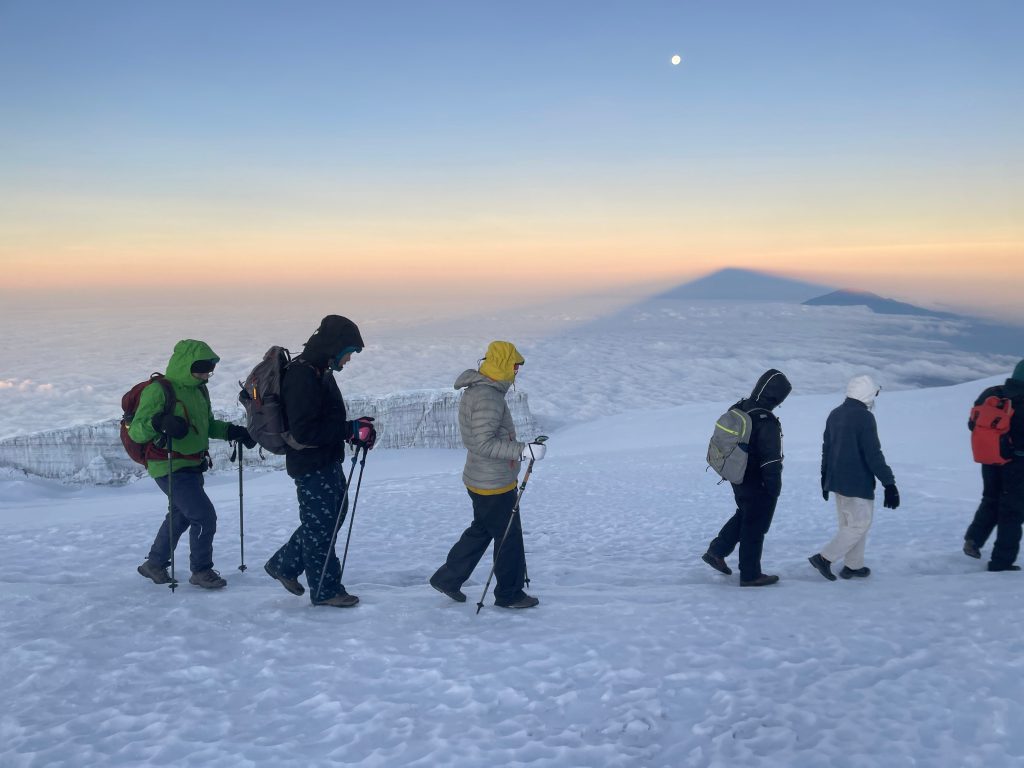
It is only about five kilometres to the crater rim. Those five kilometres take five to seven hours. Temperatures at the top sit between roughly minus seven and minus twenty degrees Celsius before dawn, and wind chill takes it lower. Most people arrive at Stella Point, or Gilman’s Point on the eastern trails, as the sky starts to lighten, then walk the rim for another forty five minutes to two hours to the wooden sign at Uhuru Peak.
You do not linger. Photographs, a few minutes to take in the glaciers and the plains below, then down. The full day from Barafu to the summit and on to Mweka Camp runs twelve to fourteen hours. Trekking poles and knee support earn their place on the descent more than anywhere else on the mountain.
Training and Fitness for a Kilimanjaro Climbing Expedition
Aim to train for eight to twelve weeks. The type of fitness matters more than the amount: this is a hiking peak, so hike. Long days on your feet on uneven ground, in the boots and daypack you will actually use, beat any amount of time on a gym bike.
A workable pattern is two or three cardio sessions a week, one long weekend walk building towards five or six hours with a loaded pack, and some leg and core work to protect your knees on the way down. Hills, stairs, anything with sustained ascent. Then taper in the last fortnight and arrive rested rather than freshly exhausted.
Guides have taken teenagers and people in their seventies to the top. Being able to walk comfortably for five to eight hours on rough ground, day after day, is the honest fitness bar.
Gear and Packing for a Kilimanjaro Trekking Tour
You cross rainforest, moorland, alpine desert and arctic summit conditions in under a week, which is why layering rather than bulk is the guiding idea. Base layers that wick, an insulating mid layer, a down jacket for the summit push, and a waterproof windproof shell over the top.
Boots must be broken in before you fly. Blisters on day two of a seven day trek make everything afterwards harder. Bring a four season sleeping bag rated well below freezing, a headlamp with spare batteries, sunglasses, sun cream, a warm hat, liner and outer gloves, and wide mouth water bottles rather than a bladder, since hose tubes freeze solid on summit night.
Park rules cap the duffel your porter carries at 15 kilograms including your sleeping bag, and it gets weighed at the gate. You carry a 25 to 35 litre daypack with water, snacks, rain gear and a warm layer, because your duffel goes ahead of you and you will not see it until camp. Sleeping bags, poles, gaiters and down jackets can all be rented in Moshi, which saves buying kit you may never use again.
Guides, Porters and Park Rules on Your Kilimanjaro Climb
The crew is not a luxury add on. Porters carry camp, water and food; the cook keeps calories going in; the guides read your condition daily and make the call on whether you go up. Load limits for porters are capped, wages are set at a minimum and paid within days of coming off the mountain, and the Kilimanjaro Porters Assistance Project monitors partner companies against a published standard.

Ask any operator directly whether they are a KPAP partner, what their guides are trained in, whether they carry bottled oxygen and a pulse oximeter, and what their turnaround policy is. An operator who talks openly about sending a sick climber down, at their own commercial cost, is telling you something useful. Rock bottom pricing usually comes out of porter pay and equipment rather than clever logistics, which is worth remembering when you compare what a climb genuinely costs to run.
Best Time for a Kilimanjaro Trekking Tour
Two dry windows carry most climbs. January to early March brings warmer days, clear mornings and a decent chance of snow on the crater rim. Late June to October is the long dry season, colder at height but the most reliable weather of the year, with July and August the busiest weeks on the trails and September a little quieter.
April and May are the long rains, and the lower forest turns to mud. November into early December sees shorter rains. Neither closes the mountain, and some people happily trek then for the solitude and the lower prices, though trails are slippery and views come and go. The northern trails hold up better in wet shoulder weeks than the southern ones.
Getting to Kilimanjaro and Where to Base Yourself
Fly into Kilimanjaro International Airport, which sits between Moshi and Arusha and is the closest option by a wide margin. Transfers to Moshi take about an hour. Nairobi is the alternative arrival point, followed by a road crossing at Namanga into Tanzania.
Moshi is the usual base, closer to the southern and eastern gates and full of climbing outfitters and gear shops. Arusha suits anyone tacking a Serengeti or Ngorongoro safari onto the trek. Either way, plan a night before your briefing so that delayed luggage does not become a crisis, and a night after the descent for a shower, a proper meal and your summit certificate.
Frequently Asked Questions About Climbing Mount Kilimanjaro
These are the questions that come up most often at the planning stage. Shorter answers to a wider set of them sit on the site-wide Kilimanjaro questions page.
How much does it cost to climb Kilimanjaro?
Packages generally run from about $1,500 at the budget end to $6,000 and above for premium private climbs, with most well supported mid range treks landing between $2,400 and $4,000 per person for a seven or eight day route. A large slice of that is fixed park charges, which is why anything advertised much under $1,500 should worry you. Budget separately for flights, a Tanzanian visa at around $50, high altitude travel insurance, tips and any gear you still need to buy.
What are the Kilimanjaro National Park fees?
The park conservation fee is roughly $70 per person per day, which comes to around $82 once the 18 percent VAT most published tariffs exclude is added. Camping is about $50 per person per night on every route except Marangu, where hut fees apply instead. There is a one off rescue fee of around $20 per climber, small entry charges for each crew member, and about $100 a night if you sleep in the crater. Reputable operators pay all of this on your behalf and include it in the quoted price.
How much should I tip the guides and porters?
Plan on roughly $250 to $350 per climber for a week long trek, and more if you are climbing solo, since one person still needs almost a full crew. The commonly used figures follow KPAP guidance: around $20 to $25 a day for the lead guide, $10 to $15 for assistant guides and the cook, and $5 to $10 per porter. Those amounts are pooled per group rather than paid by each climber. Bring clean US dollar notes from home, since cards are useless on the mountain and Moshi ATMs cap withdrawals.
Do I need climbing experience for a Kilimanjaro trek?
No. There is no rope work, no ice axe and no technical ground on the standard trekking routes. The Barranco Wall involves using your hands to scramble, and that is the extent of it. What you need is hill walking stamina and patience with a slow pace. The Western Breach variant is a different matter and is only for experienced mountaineers.
What is the highest point on Kilimanjaro?
Uhuru Peak, at 5,895 metres on the rim of the Kibo crater. Gilman’s Point and Stella Point are lower points on the same rim that trekkers pass on the way, and reaching them earns a certificate, though only Uhuru counts as the summit. Kibo is one of three volcanic cones on the massif, alongside Mawenzi and the eroded Shira.
Can beginners climb Kilimanjaro?
Yes, and a large share of the people on the mountain in any given week have never been above 3,000 metres before. The combination that works is a long route, eight to twelve weeks of walking practice beforehand, an operator with real safety protocols, and the willingness to go slowly. Wildlife along the forest zone, colobus monkeys in particular, is commonly seen on the lower days but never guaranteed.
Booking Your Kilimanjaro Trip
The safari companies and tour operators listed on this website put trips like this together for a living and know which camps, guides and routes actually deliver. We are an independent guide to Kilimanjaro; we do not book or sell tours ourselves.
When you are ready, arrange your safari, tour or holiday with one of the recognised operators listed here. Tell them your dates and what matters most, and a real person, not a form, will handle the itinerary, park bookings and logistics for you.