Marangu Route
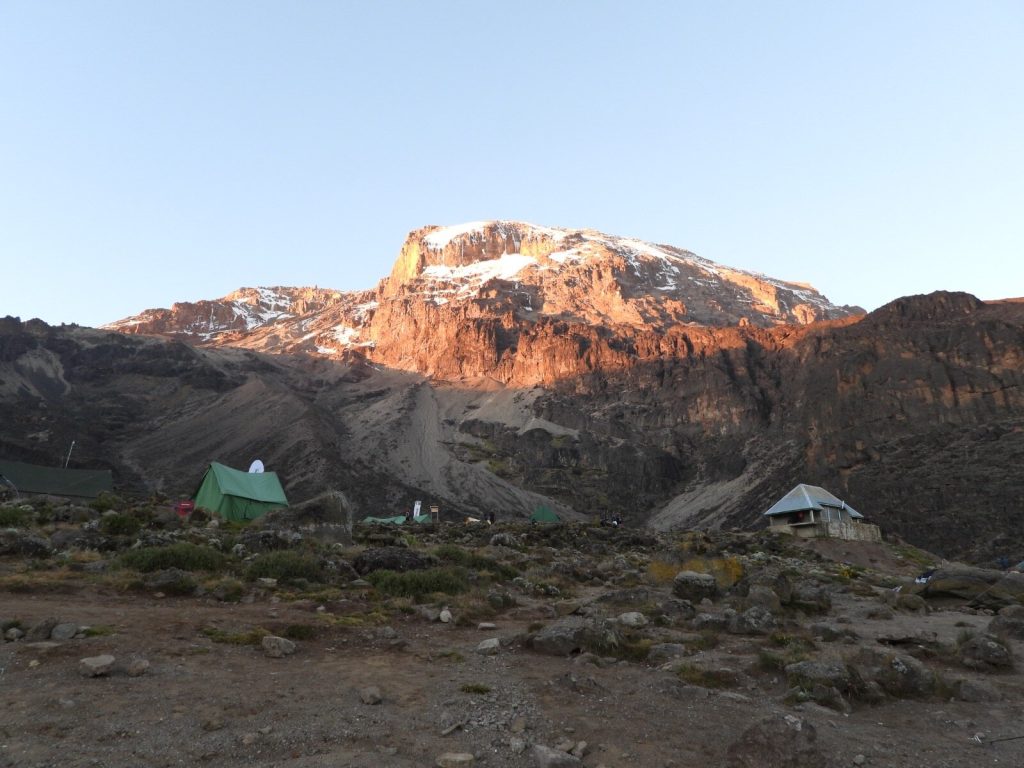
The Marangu Route is a five or six day trek up Mount Kilimanjaro from Marangu Gate on the south eastern side, covering about 64 kilometres return and using the mountain’s only hut accommodation at Mandara, Horombo and Kibo. Hut space must be booked in advance through a licensed operator. Marangu is the oldest trail in Kilimanjaro National Park in northern Tanzania and reaches Uhuru Peak at 5,895 metres.
Marangu Route Trekking and What Sets It Apart
Marangu route trekking differs from every other trekking route on Kilimanjaro in three ways. You sleep in buildings rather than tents. You walk up and back down the identical path. And your itinerary is shorter than anything else on offer, which is both its appeal and its problem.
The trail was the original tourist path up the mountain and for decades it carried more climbers than everything else combined. Machame has since taken that title, but Marangu still draws a large share of traffic, particularly from trekkers who want a roof over their heads and a gentle gradient underfoot.
The nickname, the Coca Cola route, comes from the drinks historically sold at the huts. It has done more harm than good, because it suggests a casual walk. Marangu ends at the same 5,895 metres as everything else, and the altitude does not care which trail brought you there. Total height gain from gate to summit is around 4,000 metres, and the spread between the trailhead and the high camp is smaller than on Machame, which means less of the up and down that helps your body adjust.
If beds are the reason you are drawn to Marangu, book the six day version rather than the five. The extra day at Horombo is the difference between an itinerary that works for most people and one where most people turn back short of the summit.
The Mountain Huts on a Marangu Trek
Three sets of huts serve this trail. Mandara at around 2,700 metres and Kibo at roughly 4,700 metres each hold about 60 bunks; Horombo at 3,720 metres holds 120. Mattresses and pillows are supplied, so you carry a sleeping bag but not a mat.
Facilities thin out as you climb. Mandara and Horombo have piped water from mountain streams, flush toilets and solar lighting, and Horombo has a dining hall where beer is sold, which climbers coming down from the summit tend to appreciate more than those going up. Kibo, high on the saddle, is a stone building with long drop toilets and buckets of water. There is no heating anywhere and nights well below freezing are normal.
Bunks are shared with whoever else is booked in, in rooms of roughly four to eight people. Some climbers find that sociable and some find it noisy. Either way, hut space is capped and paid for in advance, so this route needs earlier booking in peak weeks than a camping trek does.
Marangu Trek Day One from Marangu Gate to Mandara Hut
Drive from Moshi through Marangu village to the gate at about 1,860 metres, register with the park, and start walking. The path climbs steadily through montane forest for four to five hours, covering roughly 12 kilometres and gaining around 860 metres to Mandara.
The trail here is wide, well maintained and shaded, easily the most comfortable walking on the mountain. Blue monkeys turn up along the upper forest edge fairly often, along with plenty of birds you will hear before you see. It rains on this side, so a shell in the daypack is not optional.
From Mandara there is a short side walk up to Maundi Crater, a small volcanic bowl with a view out over the plains towards Kenya on a clear afternoon. It takes under an hour and it gets you a little extra height before you sleep, which is worth doing.
Marangu Route Trekking to Horombo Hut
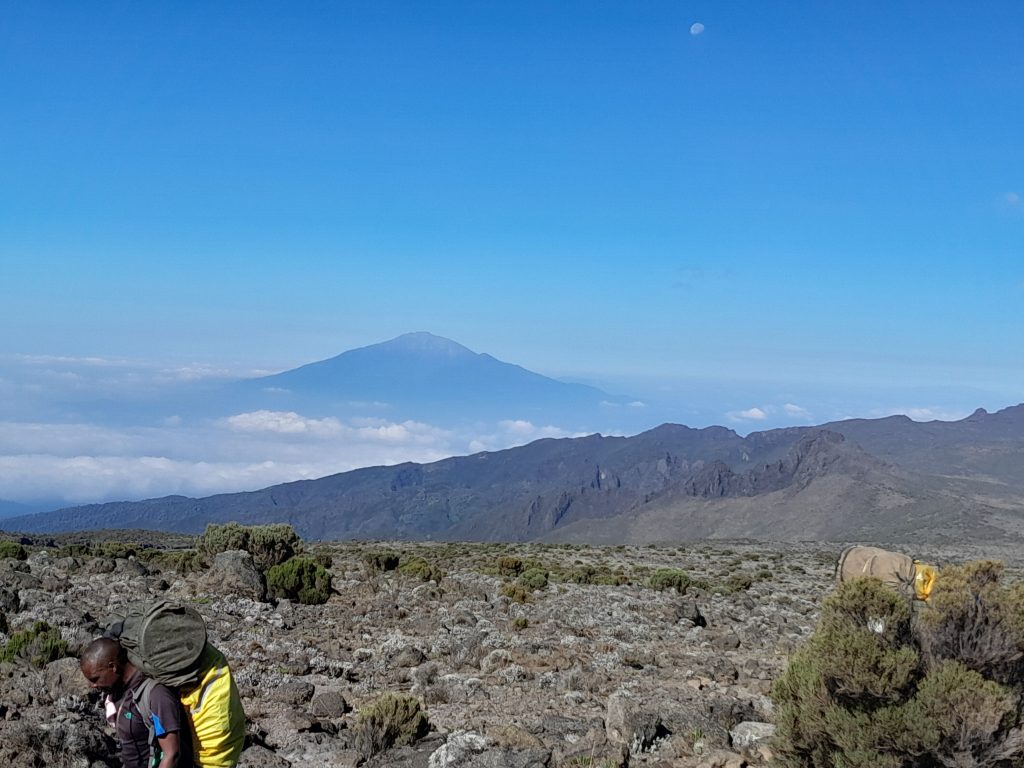
Day two is the day the mountain opens up. An hour of forest, then the trees stop and you walk out onto high moorland studded with giant lobelias and groundsels. Kibo and the jagged spires of Mawenzi come into view ahead, and on a clear morning they stay with you for hours.
Distance is around 11.5 kilometres over six to eight hours, gaining about 1,000 metres to Horombo Hut at 3,720 metres. It is a long day and the altitude begins to register in the afternoon, usually as a dull headache and a stubborn lack of appetite.
Horombo is the busiest place on the route, because trekkers going up and coming down both sleep here, sometimes twice. The atmosphere is good for it. You will get a briefing, a health check, and an early night.
The Horombo Acclimatisation Day on a Six Day Marangu Trek
This is the day that earns its keep. On the six day itinerary you stay a second night at Horombo and spend the middle of the day walking up towards Zebra Rocks at around 3,980 metres, or further onto the lower slopes of Mawenzi, before dropping back down to sleep.
Zebra Rocks is a striped basalt face where mineral streaked water has painted the stone, and it makes a pleasant target for a half day walk. The real work is invisible: several hours spent a few hundred metres higher than your bed, which is the mechanism the shorter itinerary skips entirely.
On the five day version of this trek you go straight from Mandara to Horombo to Kibo on consecutive days, with no rest and no height gained then given back. That is why the two versions of the same trail produce such different outcomes.
Marangu Trekking Across the Saddle to Kibo Hut
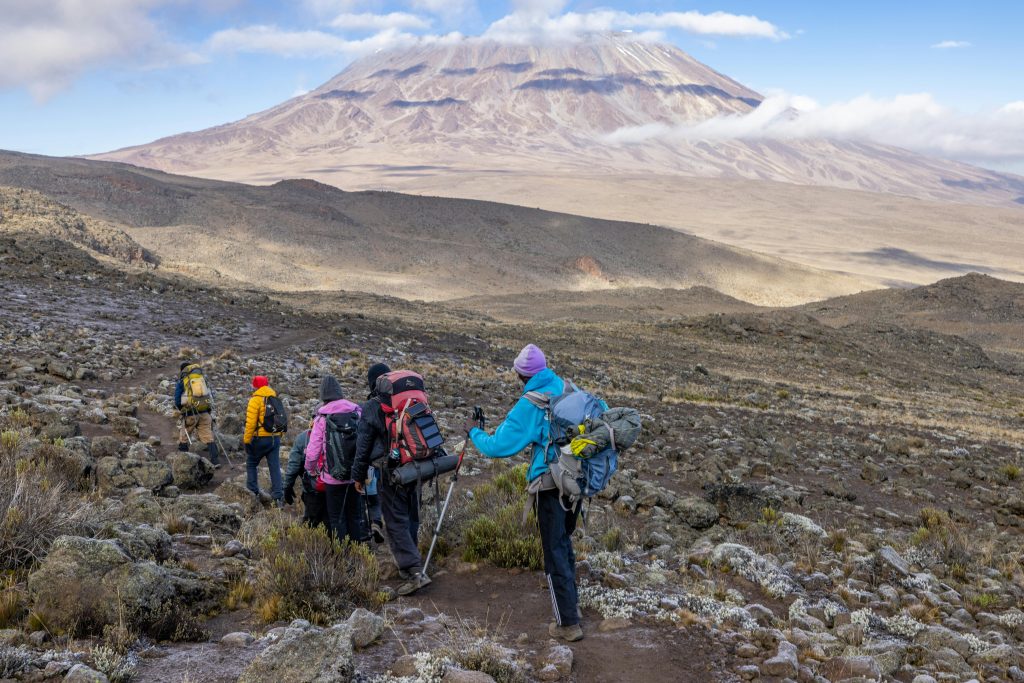
Leaving Horombo, the vegetation gives up within an hour. You cross the last stream, pass the final water point, and walk out onto the saddle, a broad stony desert between Mawenzi behind you and Kibo ahead. It is around nine kilometres in five to six hours, climbing roughly 1,000 metres to Kibo Hut at about 4,700 metres.
Nothing grows up here. Wind comes across the saddle unobstructed and the light is hard. Kibo Hut appears as a low stone block against the scree well before you reach it, and it takes far longer to arrive than it looks.
You get there in the early afternoon, eat, drink, sort your summit gear with your guide and try to sleep from around six in the evening. Water freezes overnight at Kibo, so bottles go into the sleeping bag with you.
Marangu Route Summit Climb via Gilman’s Point to Uhuru Peak
Wake up is around midnight. From Kibo the trail switchbacks up steep loose scree in the dark for several hours, and this is the section that turns most Marangu trekkers around. It is relentless, cold and steep, and the pace has to be slow enough to feel almost still.
After five or six hours you reach Gilman’s Point on the crater rim at about 5,685 metres, usually around dawn with the sun coming up behind Mawenzi. Many climbers stop here. It earns a certificate and it is a genuine achievement, but it is not the summit.
From Gilman’s it is another one and a half to two hours around the crater rim to Uhuru Peak. That is longer than trekkers arriving from the western side at Stella Point face, and it is one of the reasons the eastern approach counts as the harder finish. The rim walk is not steep, yet at that altitude after a night without sleep it asks a lot.
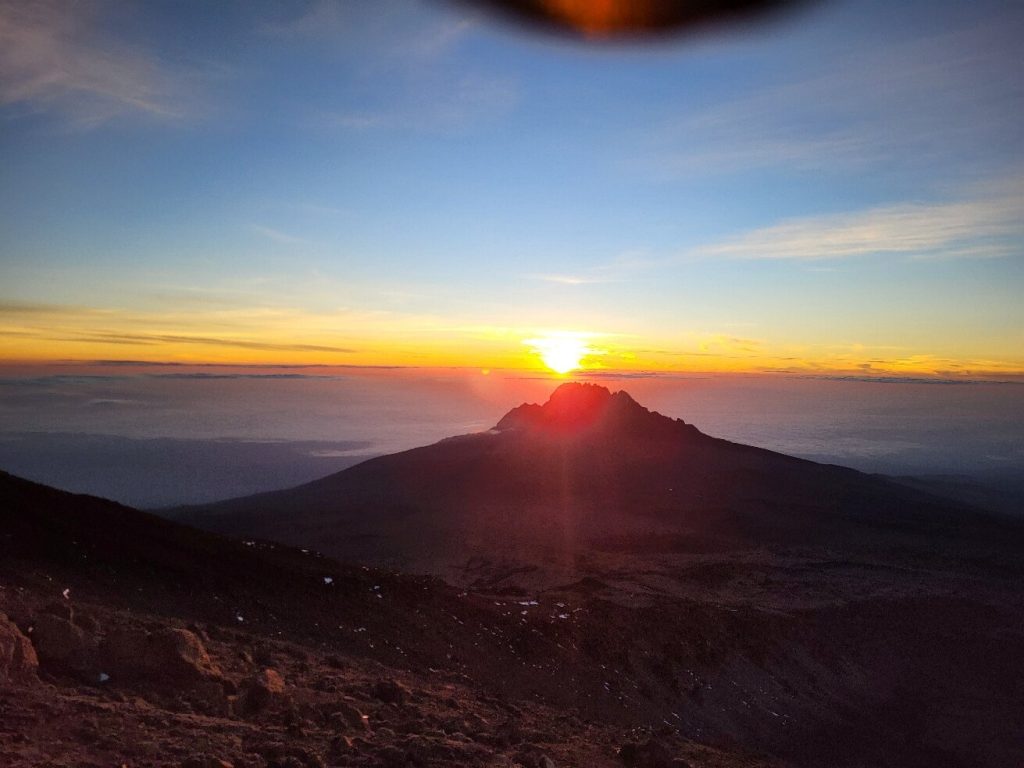
Gilman’s Point in the dawn light is where the Marangu route decides who is going on. The gradient eases from there, but two more hours of rim walking at 5,700 metres is its own kind of test.
Then back down the scree to Kibo for a rest and hot food, then on to Horombo for the night. From midnight to arriving at Horombo is commonly twelve to sixteen hours of movement. Knees complain, poles help.
Marangu Trek Descent to Marangu Gate
The final morning retraces the moorland and forest, roughly 20 kilometres to the gate in about six or seven hours, with a stop at Mandara for lunch. Because Marangu goes down the way it came up, you see the same country twice, which some people like and others find flat after the summit.
At the gate you sign out and receive your certificate, then transfer back to Moshi. The tipping ceremony with your crew usually happens either at the last hut or over lunch in town.
Five Day or Six Day Marangu Trekking
Five days. Mandara, Horombo, Kibo, summit, out. No acclimatisation day. Reported summit rates sit around 27 to 30 percent, the lowest of any itinerary on the mountain.
Six days. Adds a second Horombo night with a walk to Zebra Rocks. Summit rates commonly quoted between 50 and 65 percent, and up towards 85 percent with a strong operator and careful pacing.
Seven days. Some operators offer a stretched Marangu with an extra night. It closes much of the gap to the longer western routes and is worth asking about if huts are non negotiable for you.
Honest framing: if reaching Uhuru Peak is the priority and you have seven or eight days available, a longer camping route on Lemosho or Machame will serve you better. Marangu makes sense when time is genuinely short, when sleeping in a tent is out of the question, or when the return path suits a group who may want to split up. It is also the least expensive way up the mountain, which accounts for a good deal of its enduring appeal.
Best Time for a Marangu Route Trek
January to early March suits this trail well, with warmer days, clearer mornings and a reasonable chance of snow on the crater rim. Late June to October is the drier and colder window, with July and August the busiest and the huts at their fullest, and September calmer.
April and May bring the long rains, which hit the forest section on this eastern flank hard and turn the lower trail heavy. November into early December brings shorter rains. Hut sleeping is a genuine advantage in wet weeks, since you are not putting on damp boots outside a tent, and this is one of the few arguments that favours Marangu on the merits.
Getting to Marangu Gate for Your Trek
Kilimanjaro International Airport is roughly an hour from Moshi by road, and Marangu Gate is about 45 minutes to an hour beyond that through Marangu village, on the eastern side of the mountain. It is among the shortest trailhead transfers available, which makes for an easy first morning.
Moshi is the standard base. Book a night before your briefing and a night after you come down. Gear rental is widely available in town, and because you do not need a sleeping mat on this route your rental list is shorter than on the camping trails.
Frequently Asked Questions About the Marangu Route
How much does a Marangu route trek cost?
Marangu is the cheapest way up Kilimanjaro. Budget five day packages start from around $1,200 to $1,500 per person and six day treks commonly run $1,600 to $2,200 with a decent mid range operator. Private and premium versions go higher. Prices below roughly $1,200 usually mean the crew is being underpaid. Flights, the Tanzanian visa at about $50, high altitude insurance, tips and personal gear are extra.
What are the hut fees on Marangu?
Hut fees run around $60 per person per night, in place of the roughly $50 camping fee charged on other routes. On top of that sits the park conservation fee of about $70 per person per day, a one off rescue fee near $20, and small entry charges for each crew member. Most published tariffs exclude the 18 percent VAT. A five day trek therefore carries four nights of hut fees and five days of conservation fees, all of which your operator pays and includes in the package.
Why does Marangu have the lowest summit rate?
Because it is the shortest itinerary and its profile gives your body the least help. On five days you gain height on every consecutive day with no rest and almost no opportunity to climb high and sleep lower. Add a reputation for being easy, which attracts trekkers who have prepared less, and the numbers follow. The trail itself is the gentlest on the mountain; the schedule is the issue.
Do I need a sleeping bag if I stay in huts?
Yes. Mattresses and pillows are provided but bedding is not, and there is no heating. Bring or rent a four season bag rated well below freezing, particularly for Kibo Hut at 4,700 metres where water in bottles freezes overnight.
How much should I tip on a Marangu trek?
Around $200 to $300 per climber for a five or six day trek, scaled to crew size. The usual daily guidance, pooled across the whole group rather than per climber, is roughly $20 to $25 for the lead guide, $10 to $15 for assistant guides and the cook, and $5 to $10 per porter. Crews on Marangu are a little smaller than on camping routes since no tents are carried. Bring clean US dollar notes.
Is Gilman’s Point the same as the summit?
No. Gilman’s Point at about 5,685 metres is where the Marangu trail meets the crater rim, and it is roughly one and a half to two hours short of Uhuru Peak at 5,895 metres. Reaching Gilman’s earns a certificate and plenty of climbers stop there, particularly on the five day itinerary, but the summit is the sign at Uhuru.
Booking Your Kilimanjaro Trip
The safari companies and tour operators listed on this website put trips like this together for a living and know which camps, guides and routes actually deliver. We are an independent guide to Kilimanjaro; we do not book or sell tours ourselves.
When you are ready, arrange your safari, tour or holiday with one of the recognised operators listed here. Tell them your dates and what matters most, and a real person, not a form, will handle the itinerary, park bookings and logistics for you.